
The next generation of molecular diagnostics shouldn't be defined by compromises. For decades, the field has accepted an unspoken rule: as you increase the number of targets in a test, you inevitably sacrifice quantitative accuracy and spend months in a "validation nightmare".
We are excited to announce that our latest research, recently published in Analytical Chemistry, proves that this trade-off is no longer necessary. By leveraging our proprietary BLINK Beads (fluorescence-encoded magnetic Nanoreactor Beads), we have unlocked a path to absolute quantification and seamless scalability that was previously thought impossible.
The Legacy "Optimization Nightmare"
Traditional multiplexing is a battle against physics and chemistry. As you add more primers and probes into a single liquid reaction, you encounter:
• Spectral Overlap: Fluorescent signals bleed into one another, creating data ambiguity.
• Molecular Competition: Reagents compete for resources, leading to cross-interference and reduced sensitivity.
• Rigid Design: Adding even one new marker to a validated panel often requires a complete "ground-up" revalidation of the entire system.
A "Lab-on-a-Bead" Architecture
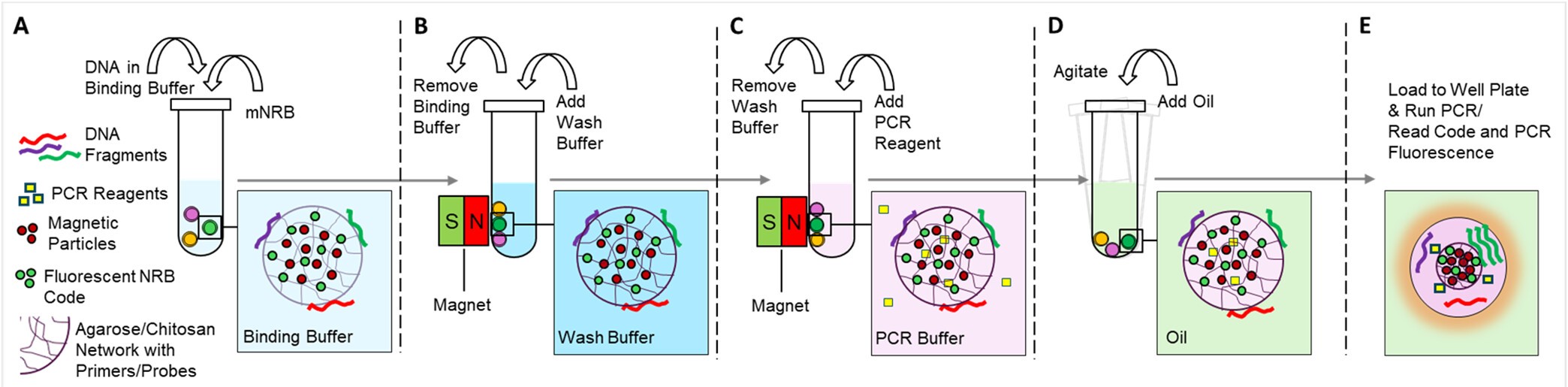
Our research introduces a fundamental shift in how assays are constructed. Instead of forcing every reaction to happen in a single, crowded liquid volume, we utilize BLINK Beads to create autonomous reaction compartments.
We are overturning the rules of molecular analysis to empower scientists with faster, more flexible, and more accurate data.
Each individual bead acts as a multifunctional engine:
• Binding Matrix: Capturing targets directly from the sample.
• Reagent Carrier: Carrying pre-loaded, assay-specific primers and probes.
• Amplification Compartment: Serving as an isolated "nanoreactor" during PCR.
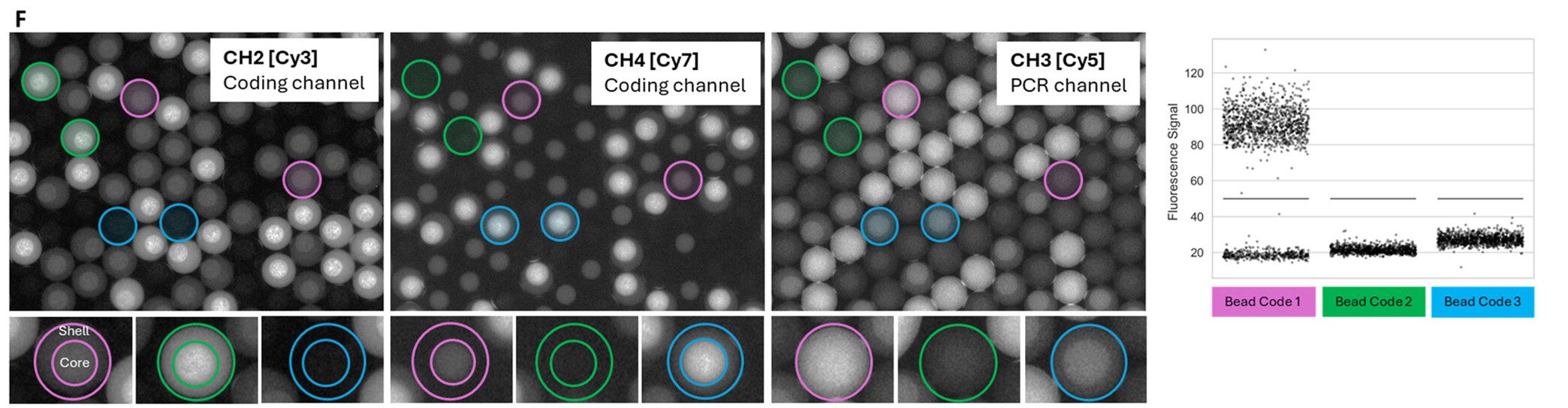
• Barcoded Identifier: Using a core-shell fluorescence coding strategy to track the identity of every single reaction.
Key Findings
Our paper details the rigorous validation of this technology, moving from a 10-assay pathogen panel to a 16-assay panel targeting species-specific markers, antibiotic resistance, and virulence.
• Seamless Scalability: We expanded our panel from 10 to 16 assays with zero additional optimization. Because each bead is isolated, the performance of the original markers remained fully intact.
• True Absolute Quantification: Our results showed excellent concordance with gold-standard ddPCR reference measurements. BLINK Beads provide absolute quantification for every target, regardless of how many assays are combined in the well.
• Microfluidics-Free Partitioning: Unlike traditional digital PCR, this is achieved without complex, expensive, or wasteful microfluidic hardware. This makes high-plex digital PCR more robust and accessible for real-world laboratory environments.
Looking Ahead: B.ONE/8 and Beyond
The capabilities described in this paper are the foundation of our upcoming B.ONE/8 instrument platform. Currently in the final stages of development, the B.ONE/8 will put this "Lab-on-a-Bead" technology into the hands of users, enabling decentralized, high-throughput molecular diagnostics without the legacy bottlenecks.
We are no longer just iterating on old methods; we are overturning the rules of molecular analysis to empower scientists with faster, more flexible, and more accurate data.
Explore the full study:
Quantitative Multiplex Digital PCR with Fluorescence-Encoded Nanoreactor Beads, Analytical Chemistry, 2026